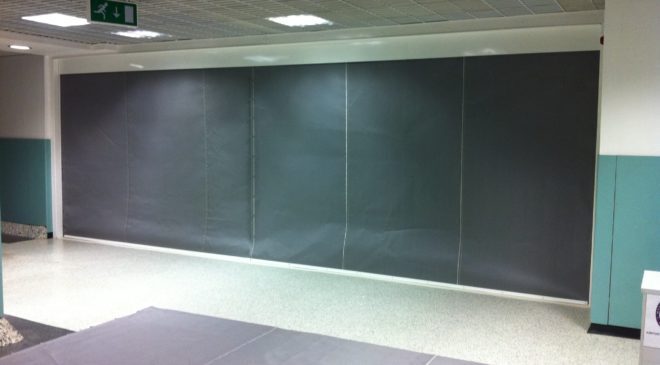
If fire curtains form part of your fire safety system, maintenance is an essential consideration.
Proper maintenance keeps your fire curtains in good working order — and protects your building and people in the event of a fire. Meeting fire curtain maintenance requirements also helps you comply with UK fire safety regulations.
But what does fire curtain maintenance involve? And how often should you be inspecting and servicing fire curtains? Let’s take a look.
Why fire curtain maintenance matters
Proper fire curtain maintenance is essential. Here’s why:
- You keep people safe. A functional fire curtain protects people from flames and smoke in the event of a fire. If you fail to meet maintenance requirements, you put people at risk.
- You meet regulations. Fire curtain maintenance is listed in the UK’s fire safety regulations. Regular servicing ensures compliance and helps you meet insurance requirements, too
- Your fire curtain lasts longer. With regular maintenance, small problems can be addressed before they turn into major issues. So you improve the longevity of your fire curtain.
- It gives you peace of mind. As a business owner, you know that your fire curtains have been properly inspected, serviced and maintained. So it’s one less thing to worry about.
What are the UK regulations for fire curtain maintenance?
According to UK regulations, fire curtain servicing has to be carried out by a “competent person”. This person should check that fire curtains are operating and performing effectively. They should also log fire curtain tests accurately.
Fire safety regulations also state that fire curtain maintenance, servicing and testing have to be carried out in line with the manufacturer’s instructions.
Fire curtain maintenance requirements: a checklist for business owners
While some maintenance tasks are best left to the professionals (more on this in a moment), some tasks can be completed by the named “competent person” within your business.
Here’s what they should be doing to meet fire curtain maintenance requirements.
Check for fire curtain obstructions
A fire curtain doesn’t provide an effective barrier against flames and smoke if there are objects in its way. So, every week, check for and remove any items of furniture that have been moved into the path of your fire curtain.
Test fire curtain operation
Deploy your fire curtain at least once a month (more frequently if your fire curtain forms part of an escape route). Check to see that it falls and rises smoothly — and ensure that automatic release mechanisms and detection sensors are working correctly.
Train and familiarise staff
It’s a good idea to test curtains at times when all staff can be present, so everyone understands how the fire curtain operates. Also, deploy your fire curtains during fire drills so everyone knows what to expect in an emergency.
Look out for wear and tear
Check the fabric of your fire curtain for any damage. If there are any rips or tears, this can impact the curtain’s performance in a fire.
Record your actions
Maintain logs of fire curtain inspections and maintenance. This acts as a handy reminder of what was done when. It also acts as proof that you’re abiding by fire safety regulations.
How often should you conduct a fire curtain service?
At Fire Door Systems, we advise our customers to book a fire curtain service with a qualified engineer at least once a year. For large, commercial buildings, a service every six months is best.
You may need to have your fire curtains tested more regularly, depending on:
- Building occupancy
- Curtain usage
- The age of your fire curtain systems
You should also conduct your own maintenance checks in between professional fire curtain servicing, as per the checklist above.
What happens during a professional fire curtain service?
A professional fire curtain service is more thorough than the regular checks undertaken by a member of staff at your company.
During a professional service, you can expect an engineer to complete the following fire curtain maintenance tasks.
Battery checks
Fire curtain batteries ensure that the curtains operate properly even when there’s a power cut. Your technician will check battery capacity and replace batteries as needed.
Checking the connection with other fire safety systems
If your fire curtain is linked to other elements of your fire safety system — for example, your fire alarm or smoke control system — a technician will check that every element is connected properly and that the fire curtain deploys reliably.
Mechanical and electrical checks
A technician will also look at fire curtain fixings, tightening and replacing parts where necessary. They’ll check that the curtain rises and falls without sticking or catching. They’ll also test your fire curtain motor, sensors and wiring.
Checking smoke seals
Depending on the construction of your fire curtain, a technician may check that smoke seals are free from damage and working correctly. They can replace any seals that don’t meet fire safety requirements.
Meet fire curtain maintenance requirements with Fire Door Systems
Fire curtain maintenance is an essential part of fire safety. It ensures that your fire curtains work perfectly in the event of a fire — preventing the spread of flames and smoke, and allowing people to escape safely.
We recommend that you book a professional fire curtain service every six months. And this is something the team at Fire Door Systems can help with.
As part of a tailor-made maintenance package, our trained and certified technicians will visit your premises according to the service schedule.
They’ll inspect your fire curtains and make any repairs or replacements. They’ll also submit a detailed service report within 24 hours of their visit.
You get fire curtains that meet regulations and protect your people. You also get complete peace of mind, knowing that your fire safety systems have been serviced and maintained by a professional fire safety team.
Want to know more about our fire curtain maintenance packages? Get in touch with the FDS team today.