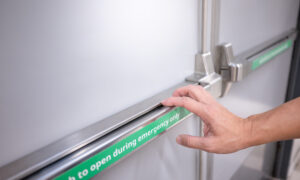
If you’re responsible for fire safety in a building, you need to know exactly how your fire doors will perform in an emergency.
So, how long will a fire door hold back a fire? The honest answer is: it depends. Fire doors are rated to hold back fire for a set period of time. But whether they actually achieve that rating depends on several factors.
In this post, we explain how fire door ratings work, what affects performance and how to make sure your doors meet your expectations (and UK regulations) in a real-life fire.
What do fire door ratings mean?
The first thing to look for when working out how long a fire door will hold back a fire is the door’s fire rating.
Fire doors are rated according to how long they can resist fire under controlled test conditions. These tests are conducted by a third-party certification company, not door manufacturers.
In the UK, fire door ratings are expressed as FD numbers:
- FD30 — 30 minutes of fire resistance
- FD60 — 60 minutes of fire resistance
- FD90 — 90 minutes of fire resistance
- FD120 — 2 hours of fire resistance
- FD240 — 4 hours of fire resistance
The higher the number, the longer the door will contain fire, protecting escape routes and limiting damage to the rest of your building.
Where can you find a door’s fire rating?
You can usually find the rating of a fire door by checking the label on the top edge of the door. The label should also list the door’s manufacturer and certification number.
Can’t find a certification label? Then you can’t be sure that this is a fire door — or know how long it will hold back a fire.
What else affects how long a fire door holds back a fire?
The rating on the label is a starting point. But it’s not a guarantee. Several factors influence whether a fire door actually performs to its rated standard.
Installation. Even a correctly rated, independently-certified door will fail if it hasn’t been fitted properly. Gaps around the frame, the wrong hinges or a closer that doesn’t function properly can all compromise performance. Only professional fire door installation can ensure a door meets its FD rating.
Frames and hardware. A fire door isn’t just the door leaf — it’s a complete system. The frame, hinges, handles, closer and any glazing all need to meet the same minimum FD rating. Only when all of the doorset meets the same fire specification will it perform as intended.
Condition and maintenance. A fire door that is damaged or that hasn’t been properly inspected and maintained over the years may not perform in a fire. Seals degrade, doors warp, wear and tear reduces the door’s strength. So regular fire door maintenance is essential.
The age of the door. In some older buildings, you may find what’s known as a notional fire door — a door that was built to provide some fire resistance but was never formally tested or certified to a specific FD rating. These doors offer an uncertain level of protection and should be assessed by a fire safety specialist to determine whether they need replacing.
Whether the door is kept closed. A fire door only works when it’s closed. A door that’s been propped open provides no protection at all. Self-closing mechanisms are essential, and door closers should be checked regularly to ensure they’re functioning correctly.
And how long does a fire door hold back smoke?
Smoke inhalation is one of the leading causes of fire casualties. That’s why many certified fire doors also carry a smoke control rating, indicated by an S suffix. An FD30S door, for example, provides 30 minutes of fire and smoke resistance.
You can check how long your fire door will hold back smoke by, again, looking at the certification label on the top of the door. Smoke-rated doors are recommended in most applications and are typically required along escape routes.
So does a fire door’s rating guarantee performance?
Not automatically. For a fire door to achieve its rated performance, it needs to be the right size of fire door. It needs to be installed correctly by a certified technician, using fire-rated frames and hardware. It needs to be properly maintained over its lifetime and kept closed at all times.
Get any of those things wrong, and even a well-rated door may not hold back fire for as long as advertised. That’s why rating is just one part of the picture.
Get expert fire door advice from FDS
How long will a fire door hold back a fire? If it’s the right door, correctly installed, independently certified and properly maintained, it’ll hold back fire for the full amount of time indicated by its FD rating.
At FDS, we can help with all of the above.
We supply and manufacture third-party certified fire doors, frames and hardware. We install fire doors in line with UK fire safety regulations. And we offer ongoing maintenance and inspection to make sure your doors perform exactly as rated — not just on the day they’re fitted, but for many years to come.
Want to be certain your fire doors will hold? Get in touch with the FDS team. We’re here to help.
FAQs
How long will a fire door stay fire-resistant?
A fire-rated door should maintain its fire resistance for the duration of its rated period — provided it’s been third-party certified, correctly specified, installed and maintained.
There’s no fixed lifespan for a fire door, but regular inspection is essential to ensure it remains in good working order. Any door that is damaged, warped or has degraded seals should be repaired or replaced promptly.
What does the S stand for on a fire door?
The S stands for smoke. You can find fire doors with ratings that include an S suffix — like FD30S. These doors act as a barrier against flames and smoke. Smoke inhalation is a leading cause of fire casualties, so smoke-rated doors are recommended in most applications, particularly along escape routes.
How often should fire doors be inspected?
Basic checks should be carried out regularly by the responsible person at your building. You should also book a professional inspection at least once every six months. High-traffic doors may need more frequent attention.
What happens if a fire door isn’t installed correctly?
It may fail to achieve its rated performance in a fire — potentially leaving people, property and escape routes unprotected. Incorrect installation can also result in non-compliance with UK fire safety regulations.
Which fire door rating do I need?
The right rating for your building depends on a number of factors, including the building type, its occupants and the level of risk in different areas.
As a general guide, FD30 doors are suitable for most residential and some low-risk commercial applications, while FD60 or higher ratings are typically required in higher-risk environments, escape routes in larger buildings or areas where fire could spread quickly.
Your fire risk assessment should indicate the required ratings for different parts of your building. And — if you’re unsure — a fire safety survey from a specialist like FDS can help you identify exactly where you need fire doors and what rating they should be.