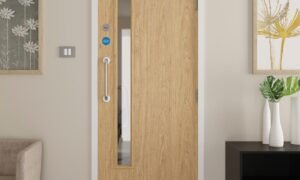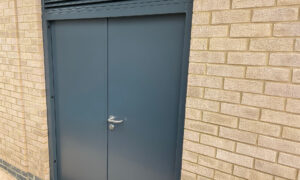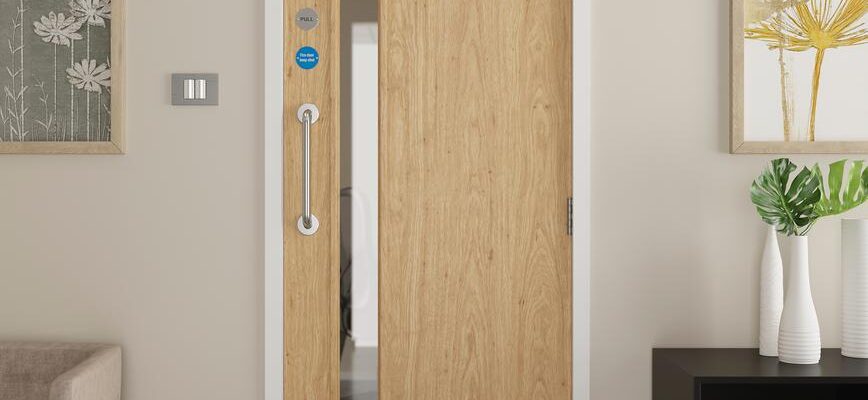
Looking for a residential fire door for a flat entrance, an HMO (house in multiple occupation) or any other domestic or commercial application? Composite fire doors are a popular choice.
In this guide, we share what composite fire doors are, where they’re used, how long they hold back fire, what they cost and more.
What are composite fire doors?
A composite fire door is a type of fire-rated door, constructed from multiple materials.
Typically, the door itself is made from a solid timber or engineered wood core, a uPVC outer skin, fire-resistant foam and glass reinforced plastic (GRP).
Around the edge of the door, you’ll find intumescent seals. These expand under heat to form a tight seal between the door and its frame, creating an effective barrier against fire and smoke.
A composite fire door helps to compartmentalise fire — it stops the fire from spreading from one room to another. This buys time, providing crucial extra minutes for people to escape the building and for the emergency services to arrive.
Read more: How do fire doors work?
Where are fire-rated composite doors typically used?
Fire-rated composite doors are most commonly used in residential settings where durability, security and aesthetics — as well as fire safety — are important. In apartment blocks and HMOs, every entrance to an individual flat should be a fire door.
Composite fire doors are a popular choice because they’re robust enough to withstand daily wear and tear, secure enough to deter break-ins and available in a wide range of styles and finishes.
For more details on where fire doors are legally required, see our guide: Where you need fire doors.
How long do fireproof composite doors hold back a fire?
To understand how long a fireproof composite door will hold back a fire, you need to look at its fire door rating.
Most composite fire doors used in residential settings are rated FD30. FD30 composite doors provide 30 minutes of fire resistance and smoke control. This is the standard requirement for flat entrance doors and HMO bedroom doors.
In higher-risk settings, an FD60 door may be required. These doors provide 60 minutes of fire protection.
If you’re unsure whether you need an FD30 composite fire door or something more robust, your fire risk assessment should provide guidance. If you don’t have one or need advice, call our team of fire door specialists for help.
Composite fire door regulations
Composite fire doors have to meet specific requirements to meet UK fire door regulations. Here’s what to look for.
Third-party tested and certified.
A compliant composite fire door must have been independently tested to BS 476-22 or EN 1634-1 — the UK and European standards for fire door performance. This testing must be carried out by an accredited third-party organisation.
Bi-directional testing.
Fire-rated composite doors have to be tested from both sides. Most fire doors are symmetrical, meaning the door performs the same way regardless of which side the fire comes from. But some fire doors are asymmetrical — with different materials, finishes or glazing on each face. To ensure a door meets its FD rating, it has to be bi-directionally tested.
All components have to meet the FD rating.
The fire rating applies to the complete doorset — not just the door leaf. The frame, hinges, closer, glazing and even the letterbox have to be compatible with the door and come with the same FD rating. Fitting a certified fire door into a non-rated frame or using the wrong hardware can seriously compromise performance and compliance.
Precise installation.
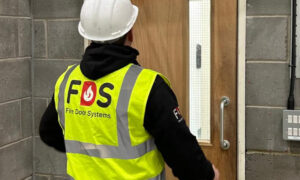
A composite fire door should be installed according to the manufacturer’s instructions. Even a small mistake can prevent the door from working properly in a fire. The safest approach is to use a certified fire door installer — someone with the training and experience to ensure the complete doorset is fitted correctly and performs to its rating.
Regular inspection and maintenance.
A fire door that was installed five years ago may not perform as well today if it hasn’t been maintained. Damage to the door — or general wear and tear — can make the door less effective. Regular inspection and prompt repair or replacement are essential.
Timber fire doors vs composite fire doors
Both timber fire doors and composite fire doors can achieve the same fire ratings. They come in a wide range of styles and finishes. New wooden doors can also meet the security specifications of composite doors.
So what’s the difference between the two?
Composite fire door benefits
- Durability. Fireproof composite doors resist warping, cracking and weathering far better than timber. They can last for decades when cared for properly.
- Maintenance. Because composite doors are stronger and more durable, maintenance costs are likely to be lower over the lifetime of the door.
- Insulation. Composite doors tend to offer better thermal insulation, which can help to lower heating bills.
Timber fire door benefits
- Sustainability. Timber fire doors are more environmentally friendly. It’s easier to recycle a timber door when it needs to be replaced.
- Cost. Wooden doors tend to be less expensive than composite fire doors. However, you need to take maintenance and replacement costs into account. Timber doors don’t always last as long as composite doors.
How much do composite fire doors cost?
Composite fire door prices vary depending on the design of the door, glazing and security features.
Look online, and you’ll find prices ranging from £900 to £1,300 for a standard composite fire door. Bespoke fire doors — made to non-standard sizes or to specific design requirements — will cost more.
It’s important to note that these prices are usually for supply only. Professional installation, door frames, hinges, closers and other hardware are additional costs that can add significantly to the overall price. When comparing quotes, make sure you’re comparing like for like.
At FDS, our composite fire door prices are inclusive. There are no hidden costs. Our quotes include the door, all necessary hardware and professional installation by our accredited team.
Get in touch for a tailored, no-obligation quote.
Fire Door Systems: your composite fire door supplier
Composite fire doors provide a combination of fire protection, durability, security and aesthetics. So it stands to reason that they’re one of the most popular choices for flat entrances, HMOs and external commercial settings.
At FDS, we’re specialist composite fire door suppliers. We supply, manufacture and install fire-rated composite doors for residential and commercial buildings across the UK.
Every door is independently and bi-directionally tested and certified. Every installation is carried out by our accredited team. And every project comes with honest, straightforward advice — so you get exactly the right fire door for your building.
Get in touch with the FDS team to chat about your fire door requirements.
FAQs
Are composite doors fire rated?
Not automatically. Standard composite doors are not fire rated unless they’ve been specifically designed, tested and certified as fire doors. To check whether a composite door is fire rated, look for a certification label on the top edge of the door. If there’s no label, you can’t assume that the door is fire rated.
Where do you need external composite fire doors?
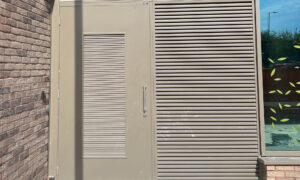
External composite fire doors are typically required where an external entrance also needs to provide fire resistance.
Common applications include flat entrance doors in apartment blocks and HMOs, and external doors in commercial buildings where you need to prevent fire from spreading to surrounding structures.
Your fire risk assessment should identify where external fire doors are needed.
Can I fit a composite fire door myself?
Technically, yes. But it’s not recommended.
Fire door installation has to be precise — the correct gaps around the frame, properly fitted seals, the right hinges and a functioning closer. Errors that would be minor in a standard door installation can significantly compromise fire door performance.
If you want to ensure safety and compliance, use a certified fire door installer when fitting fire-rated composite doors.